

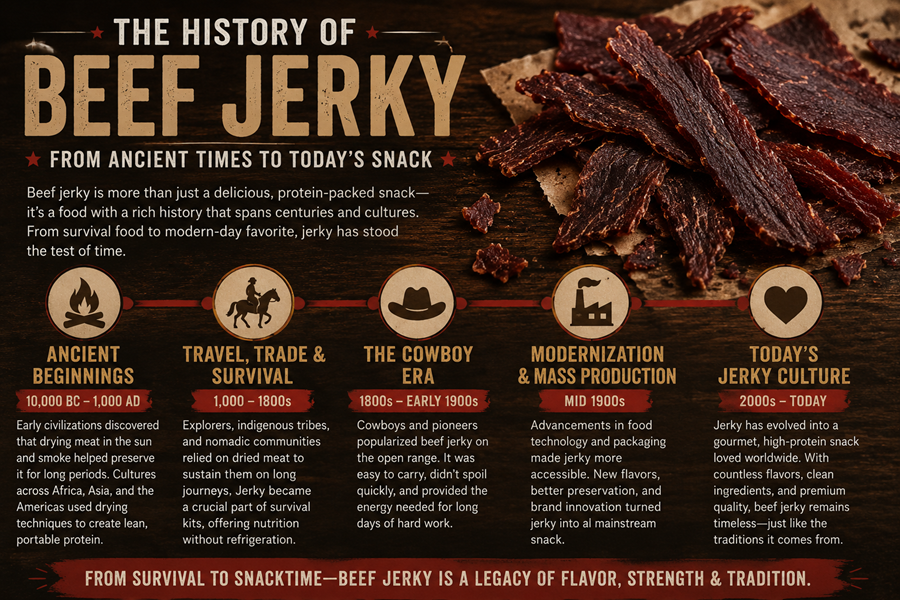
Few snacks have lasted quite like beef jerky. The savory, chewy, high-protein food is loved worldwide by travelers, athletes, campers, and professionals on the go, but the story of this tasty treat actually dates back thousands of years.
The history of beef jerky is inextricably linked to ancient survival strategies, traditional food preparation, and innovative food preservation techniques that emerged across different cultures.
From its humble beginnings of being sun-dried by ancient societies, to the gourmet, flavored jerky sold in today’s stores, jerky has become a global phenomenon.
The Early History of Jerky Preservation
The history of jerky preservation began in ancient civilizations that struggled with the long-term preservation of meat. Long before refrigeration was available, cultures used drying, salting, and smoking as primitive food preservation techniques.
Many historians credit ancient peoples of South America as the first to perfect jerky preparation.
The Quechua people of the Inca Empire made a dried meat known as ch’arki, which translates to dried or burned meat, the very word from which our word ‘jerky’ derives.
The Incas would slice llama, alpaca, and other meats into thin strips, and then let them dry either in the hot, high-altitude sun or over fires at great heights.
This preserved the meat for months, helping communities store provisions throughout harsh winters, during long journeys, and through periods of scarcity, and the process quickly spread to other parts of the world through traders and explorers who recognized the importance of this preserved meat.
Beef Jerky’s Origins in Indigenous North America
The Original beef jerky in North America includes Native American cultures, who also perfected techniques to preserve animal meats such as buffalo, deer, and elk.
Indigenous tribes would salt and smoke thin strips of meat to enhance both their preservation and their flavor, and they also produced a nutrient-dense dried meat and berry mix known as pemmican, which was a crucial part of their diet for long hunting trips or migrations.
When European explorers and settlers arrived in North America, they learned preservation techniques from the local indigenous people.
As trade routes expanded, dried meats proved extremely valuable to traders and travelers alike because they were lightweight, and easy to carry great distances over extended periods of time.
Jerky During Exploration and Trade
During the Age of Exploration, the need for non-perishable foods was critical, and dried meat was a staple among sailors and travelers.
Long trips across the sea, which would last months, necessitated foods that could be stored easily and which retained much of their nutritional value.
Jerky, needing no refrigeration, was a valuable commodity to soldiers and explorers alike, while cowboys of the American West depended on the snack for sustenance on long cattle drives of the 1800s.
Carrying fresh meat over miles and miles was impractical so jerky became a practical, filling source of energy for the busy workers, ranchers and pioneers that traveled the western frontier.
The growth of cattle farming in America then led to beef becoming a more widely available option, and it ultimately replaced other animals commonly used in traditional jerky-making practices.
Modernization and Industrialization of Beef Jerky
In the 20th century, a new phase in jerky history began to develop with the advent of modern food processing and packaging. Advanced technology and new preservation techniques, such as vacuum sealing, allowed jerky to be produced on a mass scale.
This also made it possible for the product to be distributed across the United States and then around the world. By the 1970s and 80s, beef jerky was rapidly gaining traction as a portable, high-protein snack, a food favorite among the nation’s outdoorsmen, truck drivers, and athletes.
The history of beef jerky also shows a transformation in the kinds of flavors that people enjoy. Traditional salty jerky was replaced by a vast array of flavors ranging from teriyaki, peppered, barbecue, and honey-glazed to spicy variations.
Modern companies began to use higher quality ingredients, experimenting with smoking methods, marination processes, and prime cuts of beef to make delicious gourmet jerky products.
Jerky in Today’s Snack Culture
Currently, beef jerky is not merely a dried meat product but a globally popular mainstream snack.
For health-conscious consumers, jerky has become a great choice because it is high in protein and low in carbohydrates, and many athletes add it to their post-workout diet as a way to restore lost energy levels.
Today’s brands now offer organic, grass-fed, low-sodium, and preservative-free options that are highly sought after, and the selection of jerky extends far beyond just beef, including turkey, chicken, pork, venison, salmon, and even plant-based variations.
Social media and online marketplaces have helped to foster the popularity of small, artisan jerky businesses that produce unique, internationally inspired products featuring flavors like Korean barbecue, Mexican spices, and Southern smoky recipes.
The Lasting Legacy of Jerky
There are few food items that boast as long and illustrious a history. From ancient civilizations that thrived on dried meats to the convenience store aisles we see today, jerky has survived because of its practicality, nutritional value, and flavor.
It’s a food that illustrates ingenuity and resilience-a way of preserving food for long periods of time long before the availability of modern technology.
It began as a survival food but has evolved into one of the most easily recognizable and widely consumed snack products on the planet.
Conclusion
The story of beef jerky through history is one of innovation, cultural interaction, and culinary change. It started as a necessity for ancient peoples but, due to its practicality and nutritional benefits, it has remained a popular snack for millennia.
The author of this article is a dedicated writer focused on food and lifestyle, with a special interest in exploring traditional cuisines, modern snack trends, and the rich histories behind them.